Customer segmentation help marketers to launch strategies, more precisely, for product offerings, communication content and mood & tone, and other marketing elements.
Customer segmentation methods
Roughly, there are 2 types of segmentations.
- Rule-based segmentation
This method starts with specifying some rules of analysis, e.g., segmenting customers by their occupation, age groups, etc.
One of the well-known model for this method is RFM (Recency, Frequency, Monetary) Model. There’s specification of tiers in each dimension according to different businesses. Each tier of each dimension would heave clear definition.
The example of tier specification (5 tiers in each dimension)

At the end, marketers won’t have strategies for all 125 segments. They would launch strategies for some grouped segments.
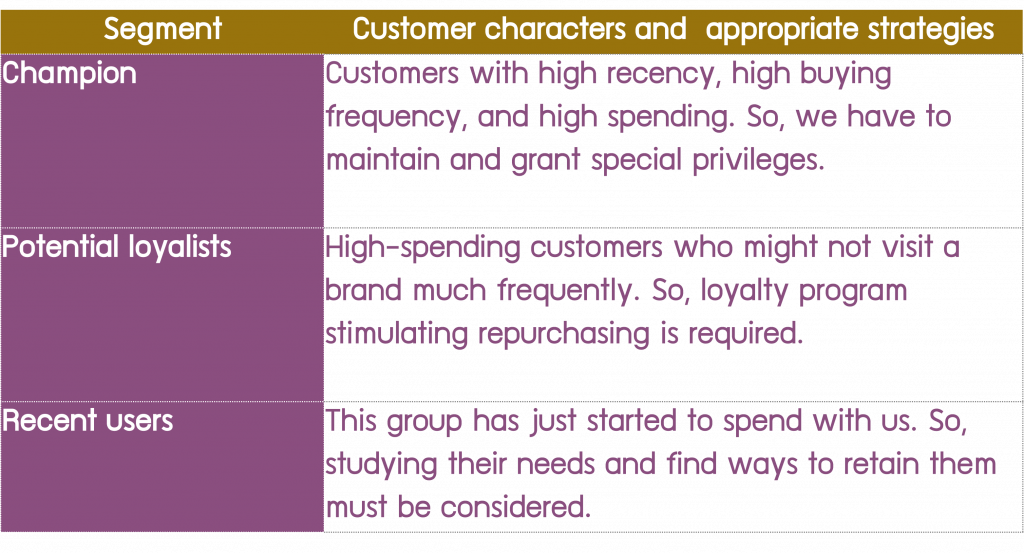
Below is the example of customer segments used by marketers.

Here, customer behaviors and strategies would be different across segments, for instance,
2. Unstructured segmentation
For this method, we don’t know, in advance, the no. of segments or characters of each segment. What we can do is selecting potential variables which could powerfully segment customers. Then, the model would show us segmenting powers of each variable and we could see the characters of each segment after finishing the process.
Variables which we choose to segment customers could be ordinal, scale, nominal, and interval ones.
Techniques widely used to perform customer segmentation are K-Mean clustering (for ordinal/scale variables), K-Mode clustering (for nominal variables) and Grower’s distance (for combination of many variable types, ordinal, nominal, interval).
The example of customer segmentation result in a premium, healthy-drink company (Dummy data).
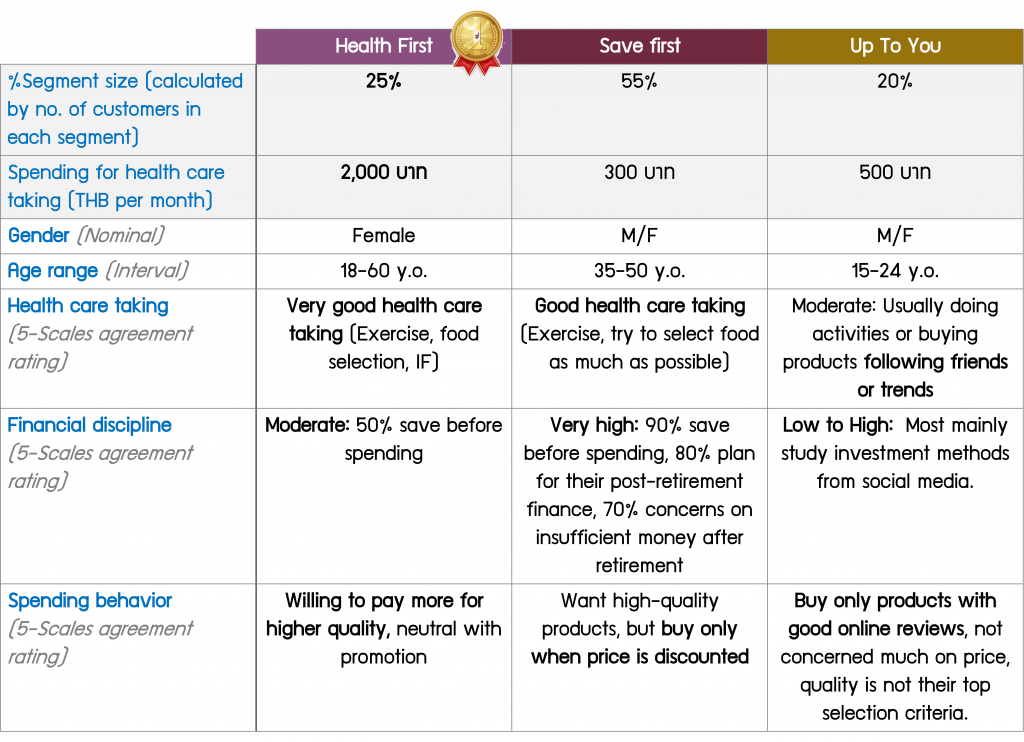
We could see that there are many variable types in the table (nominal, ordinal, interval). Actually, before processing, we don’t know segmenting power of any variable and which variables would be included in the model finally. This is different from the previous method (e.g., RFM Model) which we could know at first that segmenting variables are Recency, Frequency, and Monetary.
According to the table, we might choose ‘Health First’ segment as the 1st priority since their characters are matched with our products, followed by ‘Up To You’ segment. For the latter, we know obviously that we could do communication via social media and words of mouth.
Utlization of customer segmentation
The segmentation output is possibly that 1 customer is in 1 segment, or 1 customer could be in more than 1 segment in case the sample size is large enough. The latter is called ‘Spectral clustering’.
Marketers could launch strategies precisely for each customer segment. Furthermore, data analysts could generate predictive models, such as discriminant model (from this dataset) to predict potential segment of new customers.